Nobody Taught Me the SEO That Helps My Business
Nobody taught me the SEO that helps my own business. I had to learn seo the day I stopped chasing first place and started checking whether Google could even see my pages. You learn it the same way: not from another course, but by running experiments on your own data, one change at a time, and measuring what moved.
- Check URL status: Read whether Google has indexed this one page
- Change one signal: Fix one canonical, link or sitemap entry
- Request indexing: Ask Google to look at that URL again
- Measure the result: Record the verdict and the date
- Back to Check URL status: The measured result names the next URL or signal to check
I chased first place for terms and did not know why. I assumed that was how traffic worked. Rank first, people come, money follows. I did not know there were types of pages. I did not know there were types of queries. I had never heard the word intent used about a search. What I had was a growing pile of bookmarks and a head full of theory that never turned into a Monday morning task.
Does that sound familiar? If you have read the "how to learn SEO" guides, you know the shape of the pile. According to Coursera's step-by-step guide, which lays out a sensible sequence of what to learn, the four pillars are technical, on-page, content and off-page, and I agree with the order. What it cannot tell you is whether Google has read your page. That one fact decides whether anything else you learn can be tested, and no curriculum includes it because it is yours, not theirs.
So here is the answer up front. The SEO that helps your business is the SEO you can measure on your own site. Check if Google can see the page. Change one signal. Ask Google to look again. Read the result. Everything in the courses sits on top of that loop, and without the loop it stays theory. The rest of this is how I found that out, slowly, and what I measure now instead of guessing.
Years of Theory With No Action: How Not to Learn SEO
I bookmarked courses. I watched the videos. I read the long guides, the thorough ones that run to eight chapters and a couple of hours. Mangools' beginner guide is one of those, and it is good: it reports the fundamentals in the right order and does not skip the boring parts. I had absorbed something like it three times over. None of it was actionable, because none of it answered the only question that mattered on my site: why is nobody coming?
Then there is the advice to study the winners. Ahrefs' short video argues you can pick up most of what matters by opening the top three ranking pages for your term and reading what they do. I agree with the method. Reverse-engineering the first page is cheaper than any course. But I did it with my own pages unindexed, which is like studying the winners of a race you have not entered. The status of your own pages is the data to read first. I read it last.
That is the mistake I would save you from if I could save you from one. I was ranking-chasing before I knew what a page was for. I had pages that ranked, thousands of impressions, and very few clicks, and I did not understand why, because I had no model of who was searching or what they expected to get. My domain authority, a third-party score of how many sites link to yours, was zero. Nobody knew me. Nothing pointed at me. I kept reading.
Thoroughness does not answer whether Google is reading your pages. Only Google does.
The 2024 Domain Experiment, Told as Memory
In 2024 my site was not being crawled. Not "ranking badly". Not crawled. No impressions, no data, nothing to act on. I was posting every day, and every change took weeks to show up in any report, if it showed up at all. It felt as if Google had looked at the property and chosen to ignore it. That feeling is the worst part of starting, because you cannot test anything against silence.
Then I watched a video from a small channel, under a hundred subscribers, about the value of domains. The idea was that a cheap domain with a clean history and a little authority could lend some of it to your site, through a redirect or a schema.org sameAs (a line in the page's structured data that says "this site and that site are the same entity"). I connected that to what people called parasite SEO, publishing on a high-authority platform to borrow its standing. I put the two together. I posted an article on Medium with its canonical pointing at my own domain, which had a domain rating of zero. I bought four domains for about $12 each, domain rating somewhere between 0 and 25, added my site to their sameAs and linked them to each other. I did not redirect any of them at the domain level, because they were not all on my topic.
Within weeks, thousands of impressions a month. I kept no export, so take every number here as memory. The clicks stayed few, and the reason was not the trick: nobody knew who I was, I was not posting anywhere regularly, and I had no pages built to carry the people who did arrive. Visibility is what makes experiments possible. It does not sell anything.
What it taught me was concrete. Canonicals are instructions. Links are instructions. Pages are instructions. Google reads them and does what they say, and when my site went from silent to visible I could finally try something and see whether it worked. I would not do it today. I would build the entity properly: a Google Business Profile, sameAs on real profiles I own, one canonical per page. The lesson survived; the method should not.
What I Measured Once I Stopped Guessing
Here is what the loop looks like now, with numbers from this month. I read Google's URL Inspection API for every page in a sitemap, from a script in my own operating system, and I write the result to a CSV with the verdict, the last crawl date and the canonical Google chose.
| Site | Read | Indexed | What changed |
|---|---|---|---|
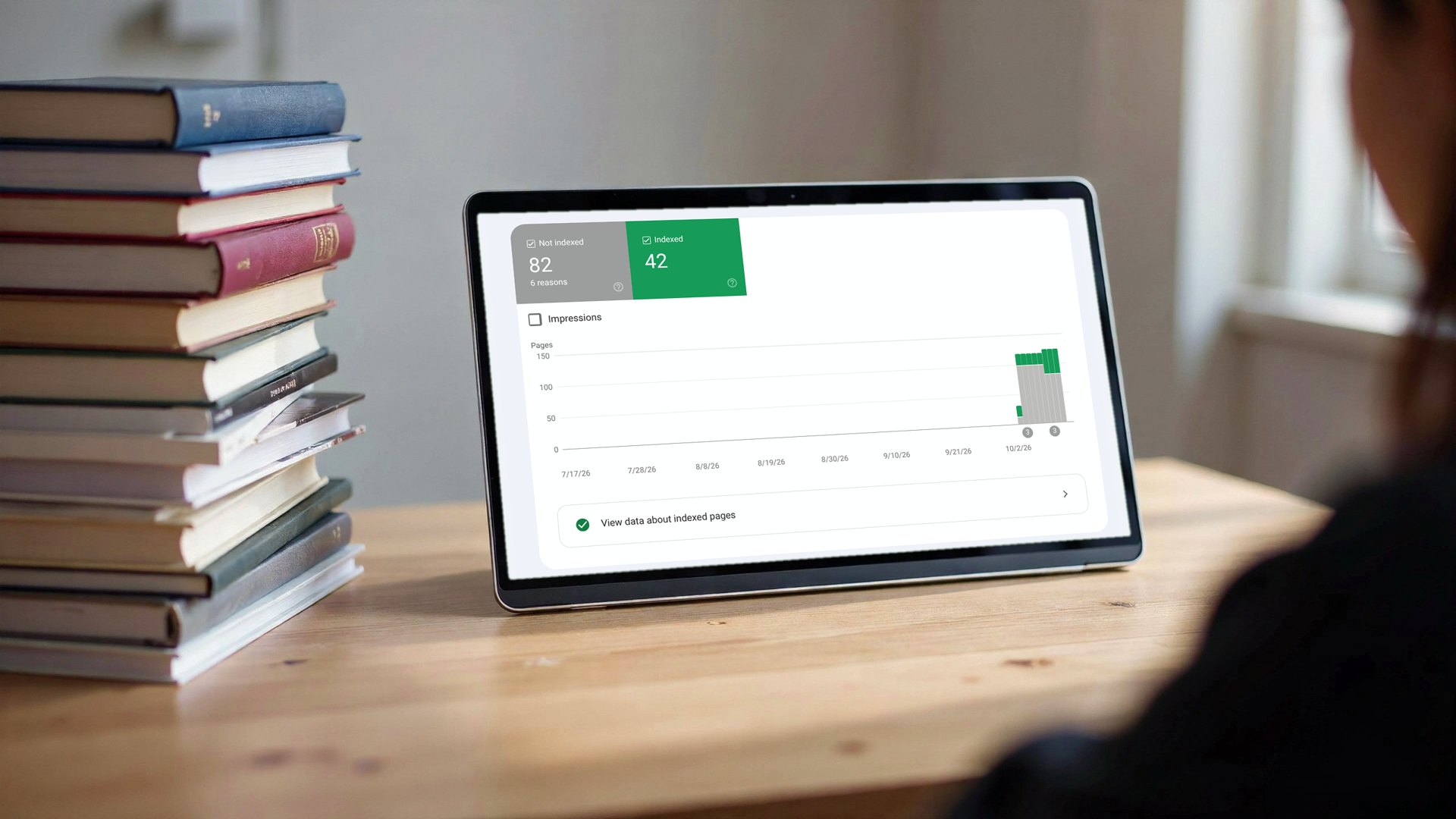
| clevrstart.com | 2026-10-07 | 19 of 103 | Nothing yet; 64 pages known and not crawled |
| clevrstart.com | 2026-10-15 | 80 of 105 | Validate Fix on 77 URLs, dates, body links; recrawls dated 10-12 to 10-15 |
| flowingkhaos.com | 2026-10-07 | 1 of 26 | The sitemap named the wrong address for every page |
| flowingkhaos.com | 2026-10-08 | 24 of 26 | The sitemap corrected, six hours later, no recrawl |
| flowingkhaos.com | 2026-10-15 | 34 of 36 | Ten new pages, all indexed; October 1 to 15: 74 impressions, 1 click |
Google's own SEO Starter Guide says there is no guarantee that any particular site will be added to its index, and I agree; the table is what "no guarantee" looks like with dates. Two things in it I could not have learned from a course. On clevrstart, zero pages on either read had a Google-chosen canonical different from mine, on a bilingual site. That settled a worry I had carried for months in one column. On flowingkhaos, the jump from 1 to 24 was not Google changing its mind; it was me telling Google the address it already had. Curriculum against experiment: the curriculum would have had me rewriting content. The experiment said the sitemap was wrong.
The method, as a list of instructions rather than tricks: check one URL's status, change one signal, request indexing, measure. The whole thing, step by step, is what how to get google to index your site shows, with the data from both sites. The script, what it reads and writes, is in google search console api, which also lists what I have not measured yet, and that list is longer than the one I have.
I will say plainly what the record cannot say. It cannot say Validate Fix caused the 19-to-80 rise, because I changed other things in the same week. It cannot give you a universal timeline. It can show you one site's dates, which is more than I had for years.
| Value (URLs) | |
|---|---|
| 2026-10-07 | 19 |
| 2026-10-15 | 80 |
What I Do Now: Five Stuck Pages and the Next Experiment
Five English service pages on clevrstart have been "Crawled, currently not indexed" since 2026-08-28. Their French twins are indexed. On 2026-10-15 I crawled the site and found that no indexed page linked to them in the body; the home page, the tools, the info pages, the about page, none. So the first change was the obvious one: a Services list in the footer of every page, in both languages, live the same hour. The next step is Request Indexing, one URL at a time, and writing down when I click.
That is the live test of a claim I make from experience and have not measured on these sites: a page with nothing broken gets indexed within about 48 hours of the request, and real rankings take two to five weeks on a domain with no history. If the five pages prove me wrong, that goes in the record too. I would rather publish a wrong number with a date than a right-sounding one with none.
Your next step is not my next step. I do not know your site or your life. I know the shape: one URL, one signal, one measurement. Pick the page that matters most to your business, find out whether Google has read it, change the one thing that is missing, and ask. Then read the result instead of reading another chapter.
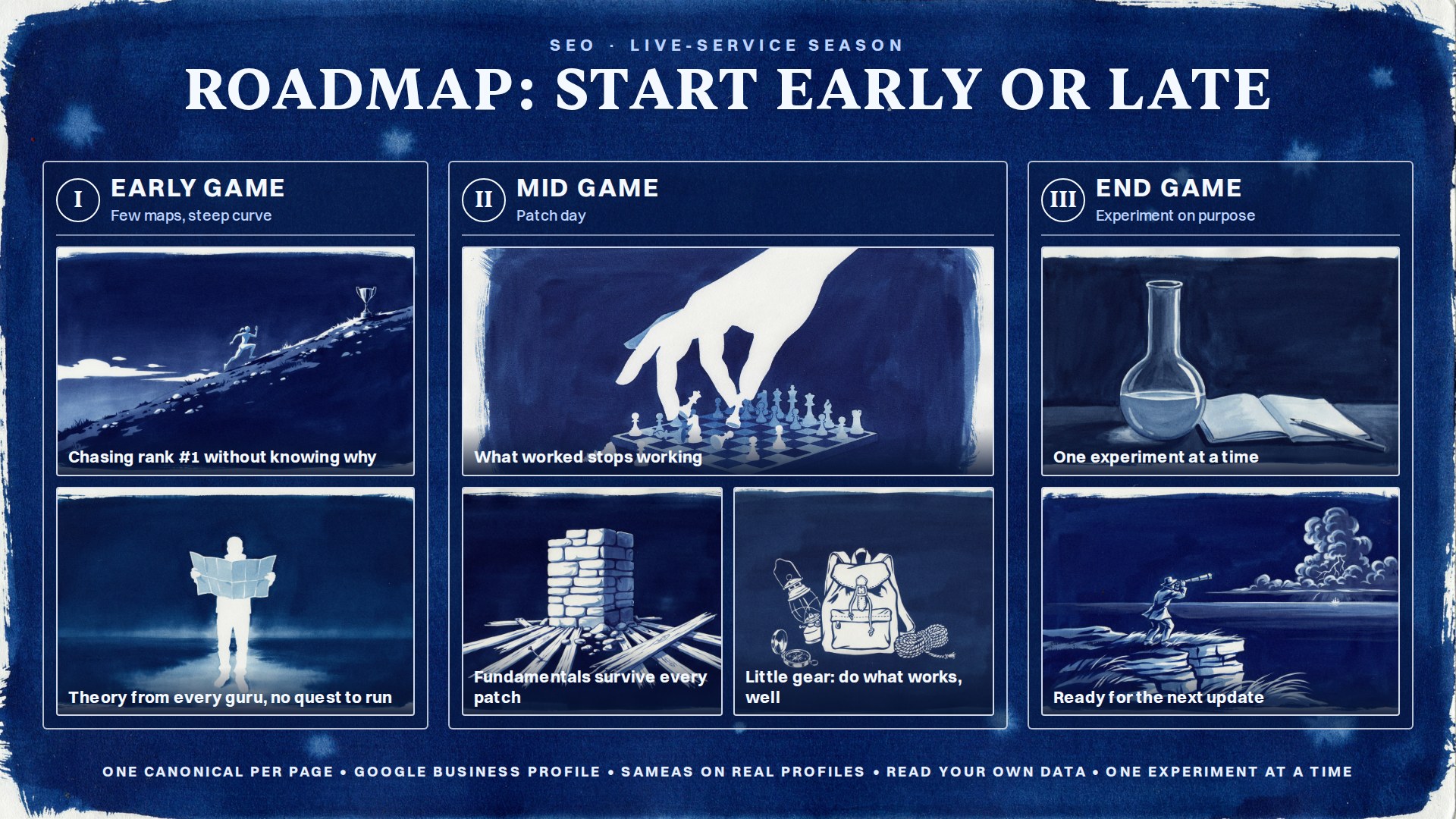
I think of the whole thing as a game that keeps getting patched, where the early levels are brutal and the late ones get boring, and SEO is a live-service game shows that frame with the same reads, phase by phase, as I see it. The short version: the course is not the answer. Your own data is, and it was there the whole time, waiting for me to ask it a question.
Sources
- How Do You Learn SEO? Step-by-Step Guide for 2026 | Coursera
- SEO Guide: Everything a Beginner Needs to Know in 2026
- Learn 80% of SEO in 14 Minutes
- SEO in the age of AI: get your pages indexed, from the API
- Why the Search Console API lives in my operating system
- SEO is a live-service game