SEO is a live-service game, and you're probably in the wrong patch
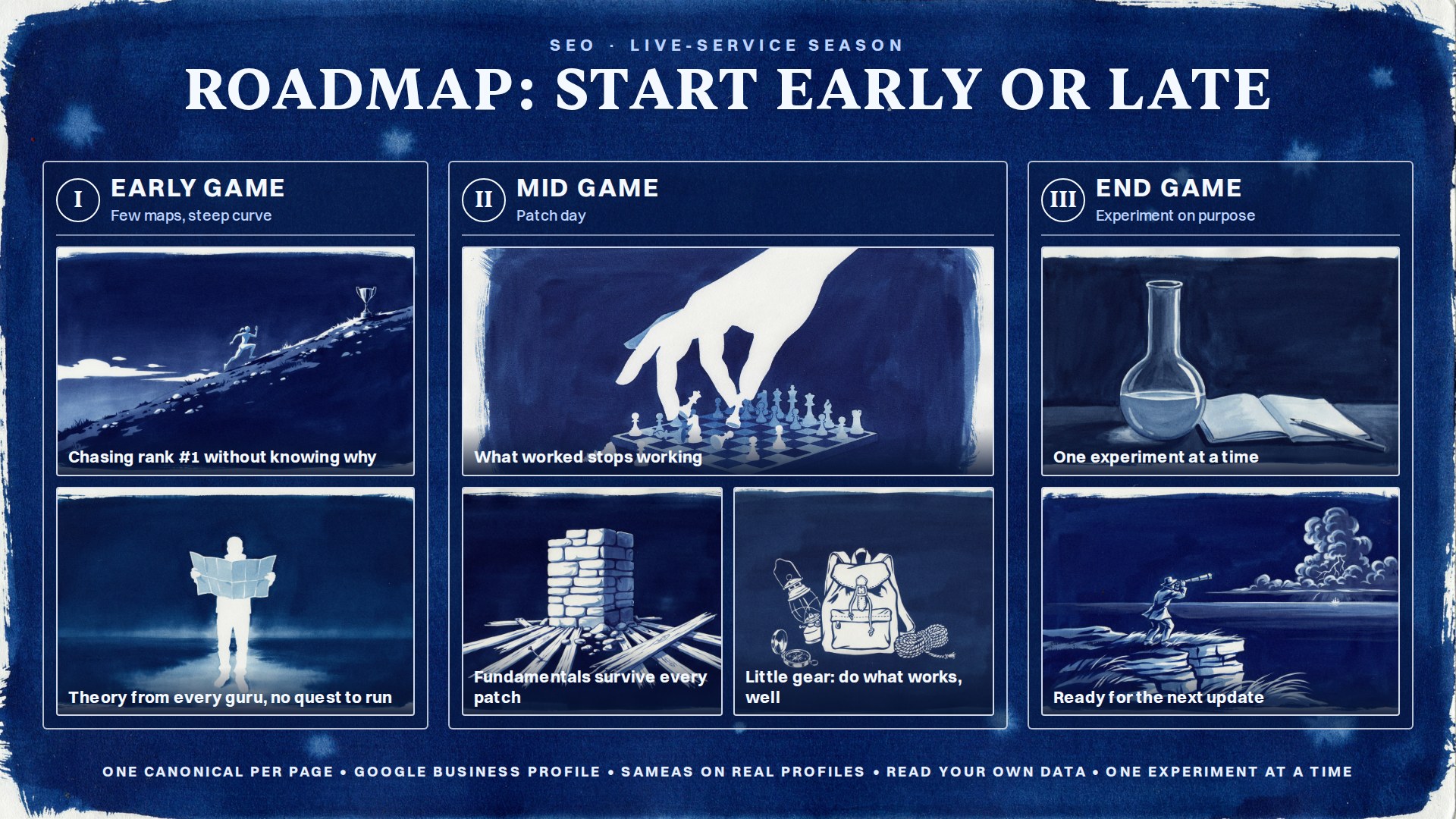
SEO is a live-service game: start early and the curve is steep, but you get to the end game where the work becomes routine; start late and the entry is cheap, but what worked yesterday may not work now, so you survive on the fundamentals, the long game, and your own experiments instead of the shiny item someone is selling. If you have been told seo is hard, that is the honest version of why.
I have read the lists. I have watched the courses. I still did not know what to do on a Monday, and I suspect you are in the same place: the pillars are the same in every guide, the guides are fine, and none of them tells you which patch you are playing in. That is the question I ask first now.
| Phase | Entry barrier | What you get | What it asks of you | Where my evidence is |
|---|---|---|---|---|
| Early game | High: few examples to learn from | Further up the curve than anyone who starts later | Patience, experiments, surviving silence | The 2024 story below |
| Mid game | The patch cycle: what worked stops working | A smaller set of things that still work | Fundamentals, done well, with little pull and few resources | The Google reads below |
| End game | Low: the loop is routine | Boredom, then room to experiment | Preparing for the next content update | The five stuck pages below |
The frame is mine, not Google's, and I use it to decide what to learn next instead of chasing whatever is new. The method behind the numbers in this piece, from the first API read to the request, is what SEO in the age of AI: get your pages indexed, from the API walks through with the data. The story of how I got here the slow way is How I learned SEO the hard way, and this piece is the frame I wish I had while living it.
Early game: why SEO is hard at the start, the steep curve nobody warned me about
Early game is harder to be good at because there are few examples to learn from. When I started, my only goal was ranking first for terms. I assumed that was how traffic worked. I did not know there were types of pages, types of queries, or a thing called search intent. I went from one guru to the next course to the next guru, and my head filled with theory that never became a task. I am naming none of them, because the problem was not any one of them; it was that I was consuming a map of a country I had not entered.
The turn came when I wrote content for my own business and watched the result. Pages ranked. Thousands of impressions. Very few clicks. My domain authority, a third-party score of how many sites link to yours, was zero. Nobody knew me and nothing pointed at me. That is the early-game feeling: you are doing the work, the board shows numbers, and nothing you can spend arrives.
It felt like player versus player versus environment. Everybody around me was chasing the latest shiny item and positioning to make more money, and most of us, me included, did not understand the worth of the items, the rules of the game, how to test a method, or how to run an experiment. Google's own SEO Starter Guide says sites that follow its Search Essentials are more likely to show up, and I agree it is the floor; what the guide cannot tell you is which of your pages Google has read, which is the number an early-game player needs most and reads last.
The upside of starting early is the one nobody mentions: you get further up the curve. Every mistake I made in silence became a thing I could recognise in a day later. The curve was steep because I climbed it without a map, and the climb is why the end game is now routine for me.
Mid game: the patch cycle and the fundamentals that survive it
Mid game is the patch cycle. What used to work no longer works. The game keeps changing, and if you start late you arrive with little pull and few resources, so you stick to what works and do it well, because that is how you survive. Play the long game. Get better at the game. Reach the end game. Then experiment like everybody else to find what works for you.
What survives a patch is the fundamentals. Google's starter guide, linked above, is explicit that there is no guarantee that any particular site will be added to its index, and I read that as a warning about the market as much as the algorithm: Pronto's plain-English guide points out that the fastest way to waste an SEO budget is to buy shortcuts, and I would go further and say a promised rank is the shortcut's sales pitch. The rank is the shiny item. The fundamentals are the boring gear that is still in your bag after the patch.
Google has started curating the learning path itself. The Search Central blog of 6 October 2026 announced learning paths for Search fundamentals and technical SEO, sorted by audience: site owners, developers, marketers. That helps, and I would send a beginner there before any paid course. But the paths are sorted by who you are, not by where your site is in its life. A mid-game player needs a second question answered: not "what should I learn", but "what is broken on my site right now". The learning path cannot answer it. Your own Search Console can, and only per URL.
The late starter's advantage is real too. The barrier to entry is lower because there is so much information and so many low-hanging rewards. The cost is that you have to understand the game fundamentally, because the tricks that built the old guides are the first thing a patch removes. If you cannot explain why a page should be indexed, you will not notice when it stops being.
End game: experiment on purpose, and what my own site measured
End game is when making it work is routine and the game gets a little boring. Then it becomes a matter of how prepared you are for the next content update and how you perform in the next patch, given your playstyle. The way I prepare is by reading my own data on a schedule and running one experiment at a time. Here is what the reads said this month, from Google's URL Inspection API, one call per sitemap URL.
| Site | Date | Indexed | Source, grade |
|---|---|---|---|
| clevrstart.com | 2026-10-07 | 19 of 103 | Search Console API, primary |
| clevrstart.com | 2026-10-15 | 80 of 105 | Search Console API, primary |
| flowingkhaos.com | 2026-10-07 | 1 of 26 | Search Console API, primary |
| flowingkhaos.com | 2026-10-08, six hours later | 24 of 26 | Search Console API, primary, after a sitemap correction |
| flowingkhaos.com | 2026-10-15 | 34 of 36 | Search Console API, primary |
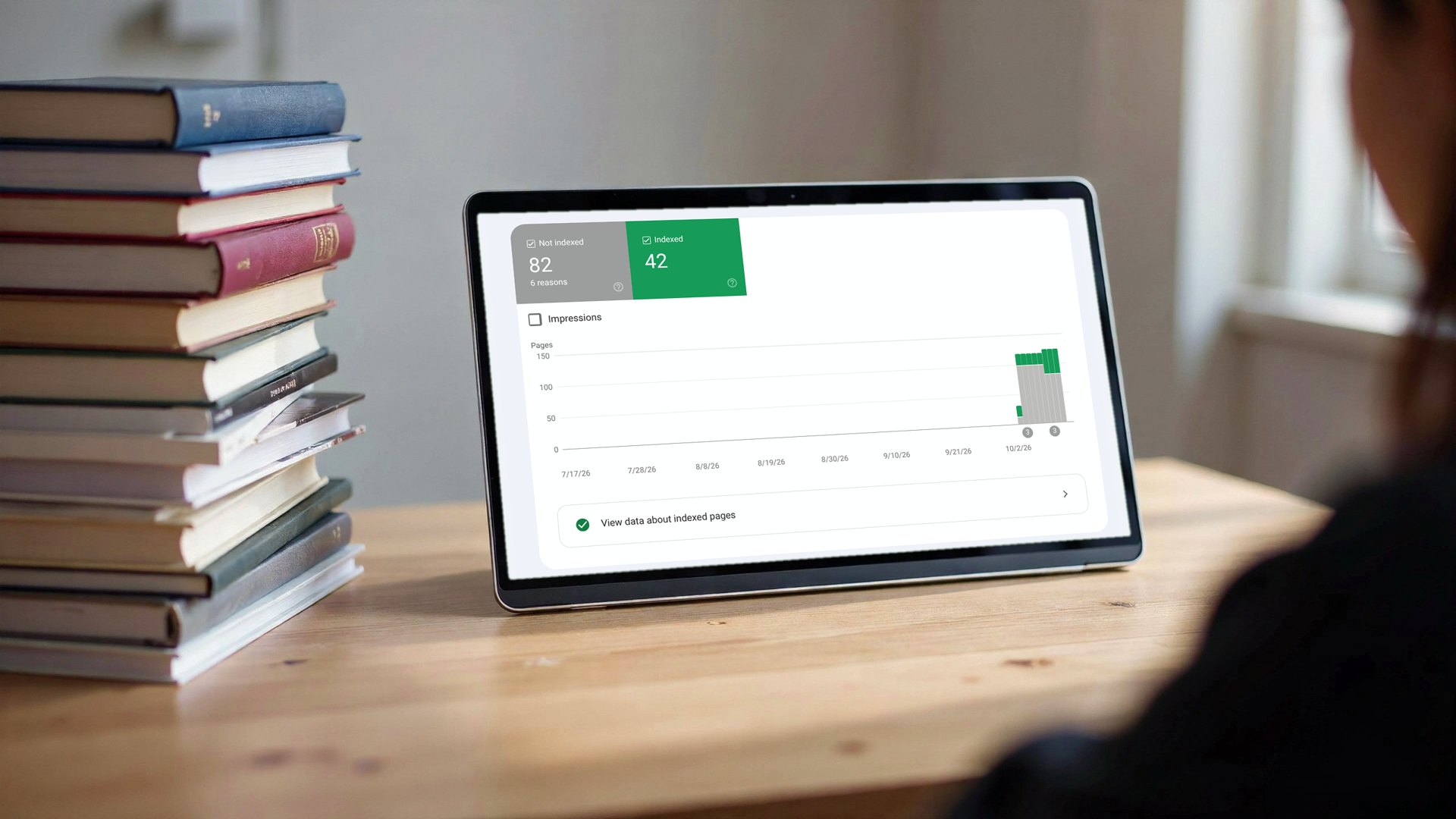
On 2026-10-15 the batch ran like this: the read finished at 16:37 UTC; a canonical fix on four legal pages (commit 605cba5) and a footer list of every service page (commit 694d211) were live within the hour. The dashboard that day showed 82 not-indexed rows; the API read of the 105 sitemap URLs showed 25, and zero pages where Google's canonical differed from mine. Validate Fix on 77 URLs had gone in on or about the 7th, and the recrawls are dated the 12th to the 15th. I will not say the click caused the rise; I changed three other things that week.
Five English service pages on clevrstart have been "Crawled, currently not indexed" since 2026-08-28 while their French twins are indexed, and no indexed page linked to them. A Search Central community guide on why services pages can be hard to index points out that overlapping or thin service pages are hard for search engines to tell apart, and I agree that is half of it; the other half is mine: the pages had no links from indexed pages on the site, and now the footer links them. A Search Central thread on recovering from a thin-content judgement when the site has real content shows a site owner asking what to fix on the site after a thin-content judgement, and the answers point at the site, not at the request, which is the same conclusion from the other side. The request comes next, with the date written down. That is end-game play: one change, one request, one measurement. The traffic side of it, what I do with visibility once I have it, is what What I do now for traffic shows, with the same small numbers and the data behind them.
| Value (URLs indexed) | |
|---|---|
| 2026-10-07 | 19 |
| 2026-10-15 | 80 |
The 2024 domain experiment, told as memory, and what I'd do today
I keep this story in every piece I write about SEO because it is the day the game became playable, and because I would not repeat it. Grade it as memory; I kept no exports.
In 2024 my site was not being crawled. No impressions, no data, posting daily into silence, changes taking weeks to appear anywhere. A small YouTube channel, under a hundred subscribers, described buying cheap domains with a clean history and pointing them at your site with schema.org sameAs. I connected it to parasite SEO, publishing on a high-authority platform to borrow its standing. I posted an article on Medium with its canonical pointing at my site, whose domain rating, a third-party score of how many sites link to yours, was zero. I bought four domains for about $12 each, rating 0 to 25, added my site to their sameAs, cross-linked them, and did not redirect any at the domain level because the topics differed.
Within weeks: thousands of impressions a month. Very few clicks, because nobody knew me, I posted nowhere regularly, and I had no pages for the people who arrived. What I felt was visible, and visible is what makes experiments possible. What I learned was that canonicals, URLs and links are instructions Google reads, and that the platforms I do not own can lend standing but cannot hold an audience.
There is a whole industry on the far end of that road. A long interview with a man who owns 200,000 domains and runs private blog networks reports that the tactic still works at scale, and I believe him about the scale; I disagree that it is a game a small business should enter, because the patch that removes it removes you with it. According to Google's link best practices, a link is a crawlable path that tells Google a page exists and what it is about, and the documentation shows the anchor text as the signal; I agree, and that is the fundamental under the trick.
What I would do today, and do: a Google Business Profile, sameAs on real profiles I own, one canonical per page, a page for every person I want to talk to, and a read of my own data on a schedule. Boring gear. Still in the bag after every patch.
Sources
- How to recover from Thin content with little or no added value when the site has valuable content?
- New learning paths: curated YouTube playlists for Search fundamentals and Technical SEO | Google Search Central Blog | Google for Developers
- Why "Services" Pages Can Be Hard to Index - Google Search Central Community
- SEO Starter Guide: The Basics | Google Search Central | Documentation | Google for Developers
- SEO Link Best Practices for Google | Google Search Central | Documentation | Google for Developers
- How Does SEO Work in 2026? A Plain-English Guide
- Black Hat SEO in 2026: Why PBNs Still Work (With the Guy Who Owns 200,000 Domains)
- SEO in the age of AI: get your pages indexed, from the API
- How I learned SEO the hard way
- What I do now for traffic