
Why Your Social Posts Never Become Visits (Answer First)
You don't get traffic by posting harder on a platform you rent. You get it by moving the people who stop for you onto a page you own, built for one person, and right now my own numbers are small enough to show you exactly how small it starts. That is my whole answer to how to get traffic to your website, and the rest of this is the practice behind it.
- Post on a rented platform: Reach there is capped by the platform
- Exchange genuinely: Answer the question asked, not the sales pitch
- Send to owned page: One page built for one named person
- Give value first: The whole answer before any ask
- Make the ask: Only after they got what they came for
You know the gap I mean. You post. The post gets reach. People react, some of them comment, and then nothing arrives on your site. The distance between someone seeing you and someone visiting you feels like a wall, and the roundups do not help much with it. Wix's guide reports that over half of small businesses get fewer than 500 site visits a month, and WordStream's list points out that 61 percent of marketers call traffic their biggest challenge; I agree with both numbers and I notice that neither article changes behaviour, because a list of 14 or 39 channels is not a decision. HubSpot has 33 ways, Shopify 27. The count is the problem.
So I do fewer things. I post regularly on platforms I do not own. I exchange with people there, genuinely, not as a funnel. And I bring the ones who want more to pages I own, each built for one specific person, where I give them what they came for before I ask for anything. The method for getting those pages seen by Google at all, the part that comes before any of this matters, is what how to get google to index your site walks through with my own data; this piece is about what happens after a page exists.
Our Own Numbers: 74 Impressions, 1 Click, and the 2024 Mistake
flowingkhaos.com, October 1 to 15, 2026: 74 impressions and 1 click in Google Search Console, with four queries that are not the site's own names. Those are my numbers, read from the API, and they are small. I publish them because a method you cannot see the starting point of is a story, not a method.
- Indexed: 1 of 26 on 2026-10-07, 34 of 36 by 2026-10-15
- Impressions: 74 from October 1 to 15 (ours)
- Clicks: 1 click in the same two weeks
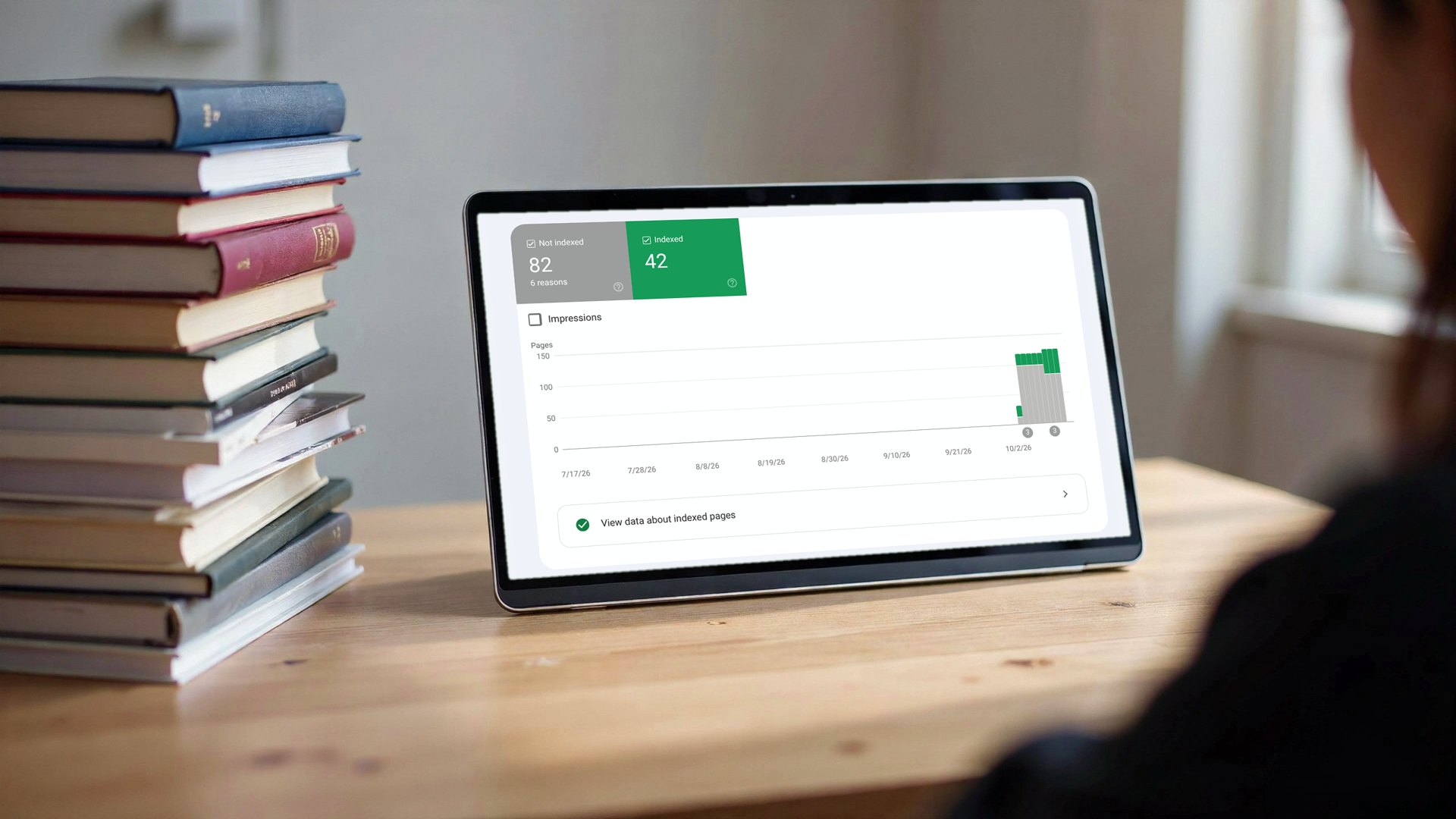
Behind them is the index. On 2026-10-07 the sitemap had 26 URLs and 1 was indexed. After a sitemap correction, six hours later, 24 of 26. On 2026-10-15, 34 of 36, including ten pages published after the fix. Visibility first, then impressions, then, eventually, visits. One click in two weeks is what the top of that ladder looks like when the pages are new and nothing links to them yet. Visibility without a page built to carry it produces impressions, not visits. I learned that in 2024 the expensive way.
That year my site was not being crawled. I was posting every day into silence. I chased first place for terms without knowing why, went from guru to course to guru, and then tried a shortcut: a Medium article with its canonical pointing at my site, whose domain rating was zero, plus four cheap domains bought for about $12 each with my site in their sameAs and links between them. Grade it as memory; I kept no export. Within weeks I had thousands of impressions a month. The clicks stayed few, and the reason was the one that matters here: nobody knew me, I posted nowhere regularly, and I had no pages for the people who did arrive. I had rented visibility and owned nothing to put it in. I would not do it today, and the practice below is what I do instead.
Why Rented Reach Never Becomes Your Audience
A platform you post on caps what you can share and how. You do not own the delivery system. You do not decide how much of your own content it will carry, in what format, to whom, or for how long. The only way someone gets the full value of what I offer is by knowing where my own platforms are, because that is the only place I control the whole of it.
The roundups mostly agree that paid is the fast lane. Shopify's guide argues that pay-per-click is the fastest way to drive traffic, and on the record I disagree with the framing, not the fact: paid buys a visit now and builds nothing that is still there when the budget stops. A walkthrough on YouTube reports a Facebook campaign at about $1,600 spent for an 11.22 return on ad spend for a silk flowers store; that is a paid case for a different kind of business, with inventory and a cart, and not a solo builder's baseline. Pixieset's list of ideas for photographers points out that the website is where the decision happens, and I agree, and would say that line is true for anyone selling a service, which is why the owned page, not the post, is the unit of work.
What rented reach does well is the first exchange. Someone sees a post, it is useful, they reply, I reply. That is real, and I would not trade it. What it does badly is memory. The platform does not remember them for me, and it will not show them the next thing I make unless the feed decides to. The owned page remembers: it is still there next week, it answers the same question the same way, and it can be found by someone the post never reached.
So the job is not more posts. It is a path from the post to a page, and a page worth arriving on.
The Method: How to Get Traffic to Your Website, One Page per Person
Here is the practice, stated as practice and not as a proven result. The numbers above are the baseline; the method is what I am testing against it.
Post regularly on the platforms where the people I want to talk to already are. Not daily for the sake of daily; regularly enough to be remembered. Exchange genuinely: answer the question asked, not the question that leads to my product. Stay active.
Move people from rented to owned by posting helpful content and relevant opinions, with the full version living on my site. The post is the first half of the answer; the page is the whole of it. I call that earned-then-owned: earn the attention where it is, keep it where I control the delivery.
Build every destination page for one specific person. One page, one person. If I cannot name who the page is for, I do not publish it. Give them what they came for first, the whole thing, and make the ask only after. Attention for value: once they have what they needed, I have their attention for what I need. One canonical per page, so the owned version is the one Google keeps; Google's SEO Starter Guide says a page should answer what the searcher needs, and I read that as the same rule from Google's side: one page, one person.
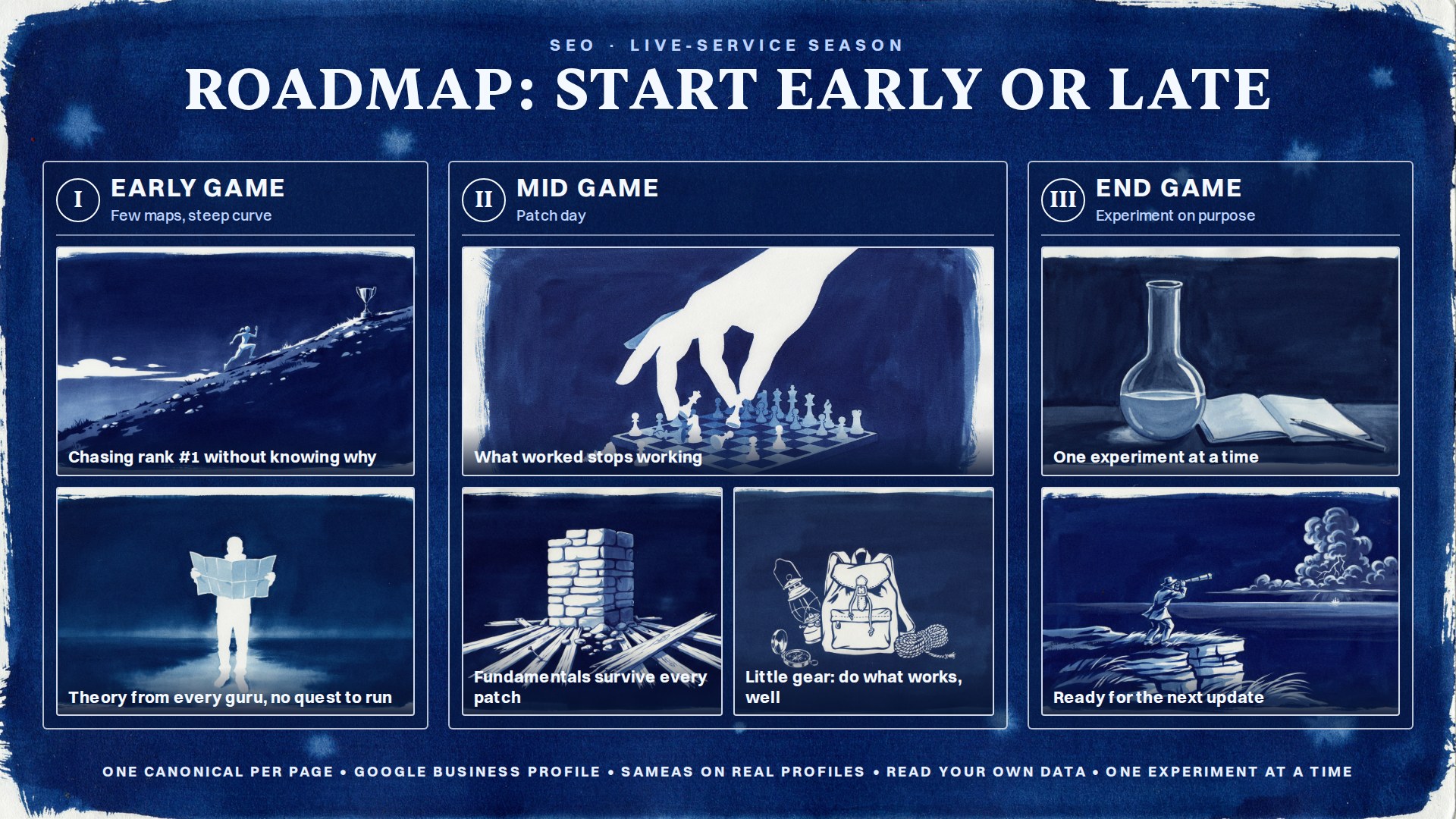
What I do not have, and will not pretend to: a conversion rate from social posts to site visits, a follower-to-visit benchmark, or referral counts. None are recorded, so none are stated. The experiments I run to find out are the end-game part of a frame I wrote down in SEO is a live-service game: start small, stick to the fundamentals, measure one thing at a time, and treat every platform change as a patch you planned for.
Join the Community: flowingkhaos, lukesidney, and Your Next Experiment
The experiments get shared in one place. flowingkhaos.com is where I write about SEO, AI, and making money online with code, with the data attached and the failures left in. The community around it lives on Whop, at whop.com/flowingkhaos, and that is the join action at the end of every column, fix and workshop there. It is for business-minded people who understand that a business career runs on two things, taking risks and investing in yourself, one to survive and the other to thrive in markets that keep changing.
lukesidney.me, where you are reading this, is the personal channel. I am Luke Sidney, in Montreal, and this is where I say the things that do not fit under a brand: how I learned, what I got wrong, what I think the game is. It points back to flowingkhaos because that is where the work lives.
My position, restated so there is no mistaking it: small numbers, published; a method, still being tested; a frame, mine, that you are welcome to argue with. 74 impressions and 1 click is where this starts. The next read goes up when it exists, whatever it says.
Your turn. Pick one platform you rent. Pick one page you own, or build it, for one person you can name. Move one conversation from the first to the second this week. Then post your own numbers, including the ones that did not move. That is the whole community: people who show their data and say what did not work.
Sources
- 14 Effective Ways To Drive Traffic To Your Website
- 39 Ways to Increase Traffic to Your Website - WordStream
- 10 ideas on how to drive traffic to your website
- Every Way To Get Traffic To Your Website In 2026 [Step-by-Step]
- Drive Traffic to Your Website: 27 Ways (2026) - Shopify
- SEO in the age of AI: get your pages indexed, from the API
- SEO is a live-service game